
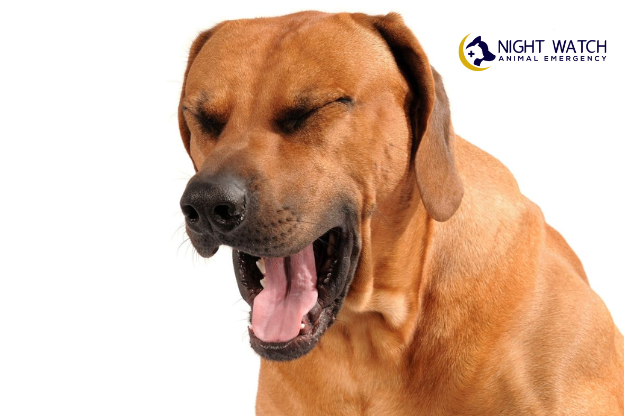
If your dog is coughing but breathing normally, acting like themselves, and the cough is mild, it may be safe to monitor briefly and call for guidance. If your dog is coughing with trouble breathing, blue/pale gums, collapse, nonstop gagging/choking, or coughing up blood-tinged foam, treat it as an emergency and seek care right away.
Dog coughing is a symptom, not a diagnosis, and it can range from a minor throat irritation to a serious heart, airway, or lung problem. As an after-hours, walk-in emergency hospital, Night Watch Elite Animal Emergency helps pet parents make fast, confident decisions when their regular veterinarian is closed. We’re open after hours and on weekends, and we’re equipped for urgent evaluation, stabilization, and advanced monitoring when needed.
Table of Contents
ToggleIs This An Emergency Right Now?
Use this quick triage. If you answer YES to any of the “Go now” items, don’t wait.
Go now (emergency)
- Breathing looks hard or fast: belly heaving, wide nostrils, elbows held out, can’t settle, or can’t lie down comfortably.
- Gums or tongue look blue, gray, or very pale
- Collapse, extreme weakness, or confusion
- Active choking: pawing at the mouth, gagging without relief, distress between coughs
- Coughing up blood (or pink, frothy fluid)
- A “can’t stop” coughing episode that lasts several minutes or returns repeatedly
- Known heart disease + new/worsening cough (especially at night or when resting)
If this is happening, go to an emergency animal hospital san antonio for evaluation as soon as possible.
Call today / same-night evaluation (urgent)
- Cough is new and persistent (hours to days), and your dog seems “off.”
- Cough comes with fever, lethargy, poor appetite, or nasal discharge
- Your dog is a puppy, a senior, or has medical conditions (heart/lung disease)
- You suspect something was inhaled (grass seed/foxtail, small toy, treat piece)
What Should I Do At Home Before I Leave?
Keep it simple and safe, especially because coughing can worsen with stress.
- Keep your dog calm and cool
- Minimize excitement, stairs, and pulling on the neck.
- Minimize excitement, stairs, and pulling on the neck.
- Use a harness, not a collar
- Neck pressure can trigger more coughing (especially with airway irritation).
- Neck pressure can trigger more coughing (especially with airway irritation).
- Check gum color
- Pink is reassuring; pale/blue/gray is urgent.
- Pink is reassuring; pale/blue/gray is urgent.
- Count breaths at rest (if safe to do so)
- If you’re also noticing rapid breathing in pets, treat it as higher urgency, especially if effort looks increased.
- If you’re also noticing rapid breathing in pets, treat it as higher urgency, especially if effort looks increased.
- Do not give human cough medicine
- Many OTC products can be unsafe or interfere with diagnosis.
- Many OTC products can be unsafe or interfere with diagnosis.
- If choking is suspected
- Only try to remove an object if you can clearly see it and safely grasp it; otherwise, head in immediately.
What Are The Most Common Reasons This Happens?
Here are the most common buckets that emergency teams consider. (This isn’t a substitute for an exam, but it helps you understand what the cough could mean.)
Could be mild to moderate (but still needs evaluation if persistent)
- Upper airway irritation (dust, smoke, perfumes, dry air)
- Infectious cough (often called kennel cough)
- Can spread quickly; may sound harsh and frequent.
- Can spread quickly; may sound harsh and frequent.
- Allergies/inflammation
- May come with sneezing, watery eyes, or a seasonal pattern.
Can be serious (especially with breathing changes)
- Foreign material inhaled
- Grass awns/foxtails and small objects can irritate or obstruct airways.
- Grass awns/foxtails and small objects can irritate or obstruct airways.
- Heart disease / fluid buildup
- Classic pattern: cough at night or when resting, reduced stamina.
- Classic pattern: cough at night or when resting, reduced stamina.
- Pneumonia or severe lower-airway disease
- Often paired with lethargy, fever, and decreased appetite.
How Can I Tell What Type Of Cough It Is?
This is one of the most common questions pet parents ask, and it’s helpful information to share with the ER team.
“It sounds like a goose-honk.”
- Often described with airway irritation (some dogs have a honking, dry cough).
“It’s wet or ‘productive'”
- May sound like mucus is moving; it can be seen with lower-airway or lung concerns.
“It’s coughing and then gagging.”
- This pattern commonly worries owners and can appear with an infectious cough or throat irritation, but if it escalates to distress or your dog can’t catch their breath, treat it as urgent/emergent.
“It’s only at night.”
- Nighttime coughing can be seen with multiple issues; if paired with decreased stamina or fainting episodes, it raises concern for heart-related causes.
Tip: A short video of the episode (10–15 seconds) can help your veterinarian understand the pattern.

What Will An Emergency Vet Check First?
At Night Watch Elite Animal Emergency, the first goal is to assess stability, then move quickly into targeted diagnostics based on what we find.
First: stabilization and rapid assessment
- Breathing effort, oxygenation, gum color, temperature, heart rate
- Triage for emergency vs urgent vs stable monitoring
Next: fast diagnostics to find the “why.”
Based on symptoms, your pet may need:
- In-house lab testing for infection/inflammation, organ function, and other urgent clues (this supports quick treatment decisions).
- Digital radiology (X-rays) to look at the lungs, airway, and heart silhouette
- Ultrasonography when a deeper look is needed
If a procedure is needed
- If a condition requires surgical intervention, Night Watch provides surgical care and monitoring for appropriate cases.
When Is It Okay To Monitor, And When Should I Schedule Care?
Monitoring can be reasonable only if:
- Your dog is breathing comfortably
- Energy is normal (still eating/drinking, responsive)
- Cough is mild and not worsening
- No choking/gagging distress, no blue/pale gums
Even then, if the cough lasts beyond a short window or keeps returning, it’s smart to schedule an evaluation, especially in puppies/seniors.
Seek urgent evaluation if:
- The cough is persistent or worsening
- You see labored breathing, or your dog can’t rest comfortably
- There’s vomiting, fever, lethargy, or poor appetite
How Can I Reduce The Chance It Happens Again?
Prevention depends on the cause, but these steps help many households:
- Reduce irritants
- Avoid smoke, heavy fragrances, and dusty environments.
- Avoid smoke, heavy fragrances, and dusty environments.
- Use a harness
- Especially for dogs prone to coughing while pulling.
- Especially for dogs prone to coughing while pulling.
- Ask your veterinarian about vaccination timing
- Particularly if your dog boards, goes to grooming, or daycare.
- Particularly if your dog boards, goes to grooming, or daycare.
- Keep an eye on pattern changes
- New nighttime cough, new exercise intolerance, or repeated coughing fits should trigger evaluation.
Frequently Asked Questions
Can a dog's cough be caused by something minor?
Yes. Mild throat irritation, allergies, or dry air can cause coughing. If it lasts more than a short time or worsens, get it checked.
Is coughing the same as choking in dogs?
Not always. Choking usually causes panic, gagging, and distress. Ongoing coughing without relief should still be evaluated urgently.
Should I worry if my dog is coughing but acting normal?
You can monitor briefly, but if the cough persists, returns often, or is paired with rapid breathing in pets, seek veterinary care.
What tests might an emergency vet run for a coughing dog?
An ER may perform X-rays, oxygen checks, and pet blood tests San Antonio to identify infection, heart issues, or lung disease quickly.
Conclusion
Dog coughing can be harmless, or it can signal a serious emergency. Trust what you see. If breathing looks hard, gums look pale or blue, or coughing won’t stop, don’t wait. Getting care early at an emergency animal hospital san antonio can make a critical difference.
When You Need Help After Hours In San Antonio
If your dog’s cough is paired with breathing trouble, weakness, or distress, it’s safest to treat it as urgent. Night Watch Elite Animal Emergency is a walk-in, after-hours emergency clinic serving San Antonio and surrounding areas, with urgent/critical care capability and rapid diagnostics (in-house labs, radiology/ultrasound).